


Basketball court tents are modular structures suitable for temporary events, semi-permanent venues, and long-term indoor basketball facilities. Whether approvals or permits are required is not governed by a unified global standard; it typically depends on factors such as local regulations, tent dimensions, duration of use, site classification, foundation type, and whether the structure is intended for commercial operation or public events.
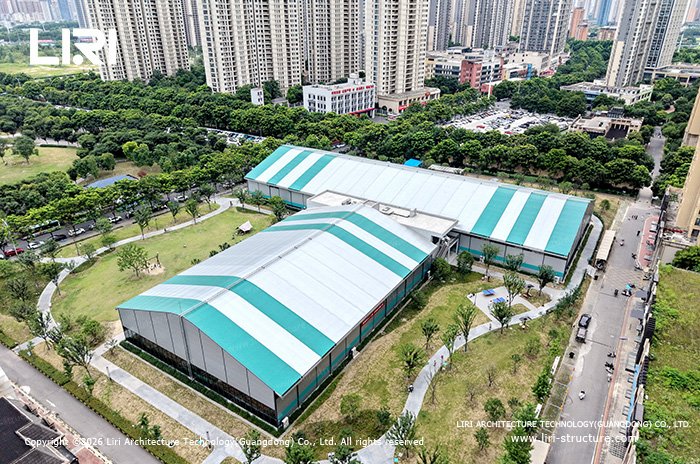
Temporary Basketball Court Tents
Temporary basketball court tents are characterized by rapid deployment and flexible dismantling, and are typically used for short-term tournaments, sporting events, temporary training facilities, and similar applications.
For temporary structures with a relatively small footprint and short duration of use, certain countries or regions may permit exemption from building permit requirements provided that specific conditions are met. However, if the tent has a relatively large footprint, an extended duration of use, or is operated as a commercial sports venue open to the public, it may generally be subject to requirements including temporary structure permits, building permits, fire safety reviews, or site use approvals.
Whether a permit is required should be determined in accordance with the regulations of the competent authorities for building, planning, and fire safety in the jurisdiction where the project is located.
Semi-Permanent Basketball Court Tents
Semi-permanent basketball court tents are typically used for seasonal venues, long-term leased sites, or sports facilities requiring continuous operation for several years or longer.
Compared with short-term temporary tents, such projects generally must satisfy more stringent structural and operational requirements, and may involve planning or land use approvals, structural safety documentation, building permits, and fire safety and personnel evacuation regulations.
Certain projects may also be subject to additional specialized approval requirements depending on the foundation type, installation location, and nature of use of the tent.
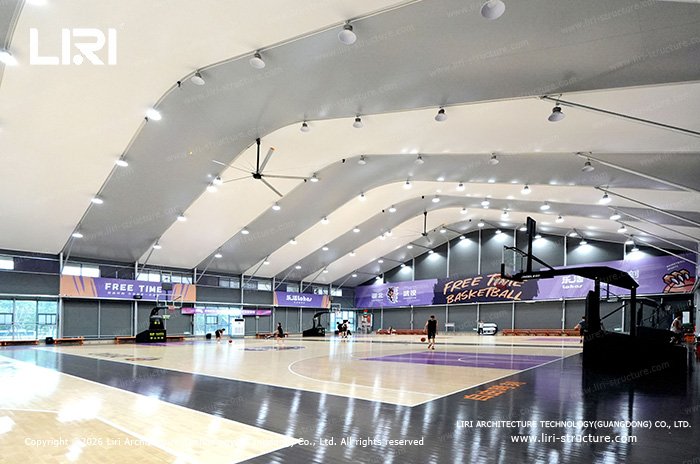
Permanent Basketball Court Tents
If a basketball court tent is intended for long-term use as a permanent sports venue, with permanent foundations and fixed ancillary facilities, its approval requirements will generally more closely approximate those applicable to conventional permanent buildings.
The project may be required to complete approvals under local building codes for planning, building permits, structural design, foundation engineering, fire safety, and mechanical and electrical systems, and to satisfy the long-term operational requirements of a formal sports venue.
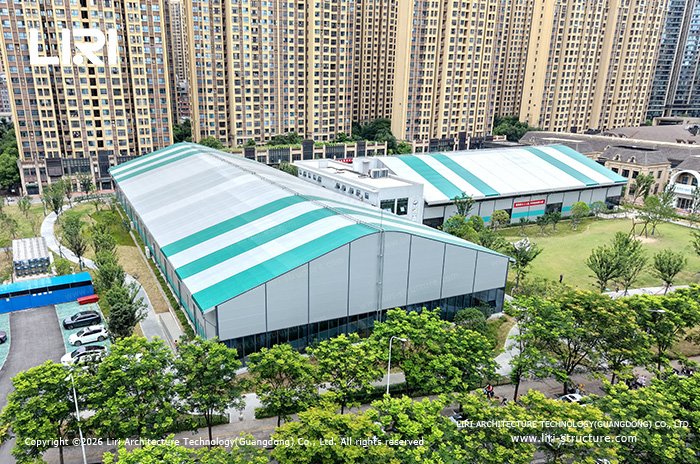
What Factors Affect Basketball Court Tent Permit Requirements?
Regulations may vary considerably across different countries, regions, and even municipalities. In general, the following factors influence whether relevant permits are required:
- Tent footprint, height, and overall structural scale
- Temporary, semi-permanent, or long-term duration of use
- Land use and planning designation of the site
- Whether permanent foundations are adopted
- Whether the structure is used for commercial operation
- Whether the venue is open to the public
- Maximum occupant capacity of the venue
- Fire safety, evacuation, and structural safety requirements
Accordingly, prior to finalizing a basketball court tent solution, it is advisable to ascertain in advance the building, planning, land use, and fire safety regulations of the jurisdiction where the project is located, and to prepare the requisite structural design and technical documentation in accordance with the requirements of the local competent authorities.
Whether a basketball court tent requires approval cannot be determined solely on the basis that it is a “temporary structure” or a “modular structure”; rather, it should be comprehensively determined based on the specific project conditions and local regulations.


 Liri Structure is the best marquee tent manufacturer, supplier, exporter in China. Our party tents, wedding tents and event tent structures have been exported to over 130 countries.

